

Date
06.2026Everything Drifts Crabwards
The pretty incongruities of Deep Time.
Evolution has its favourites
How would you explain the concept of a meme to a medieval peasant? Richard Dawkins, the evolutionary biologist who coined the term, had something rather more serious in mind than the tired little joke your mates drop into a WhatsApp group, or the memory of an afternoon surrendered to doomscrolling. In its more academic sense, a “meme” is a unit of information that manages to reproduce itself: a tune, a technique, a superstition, a phrase, a gesture, a theory, a slogan. A pattern that persists through time, mutates and adapts. Not because of the intrinsic worth of its content, rather its effectivess as a mechanism of transmission.
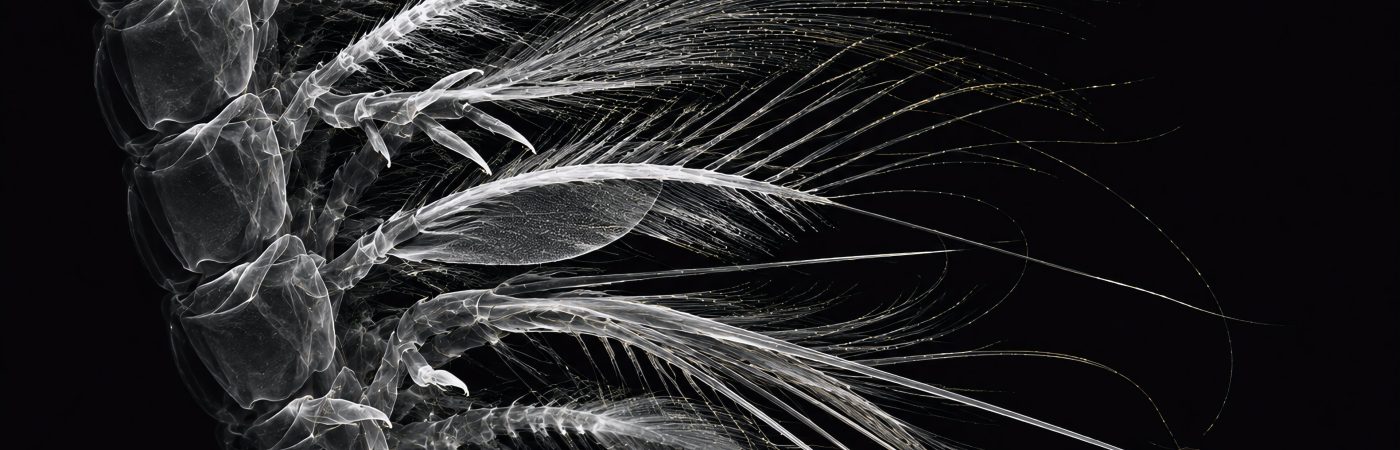
Crabs are a meta-meme. “Carcinisation” is the evolutionary term for the way the archetype of what we recognise as a crab keeps reappearing in the fossil record over hundreds of millions of years, across lineages of creatures with little or nothing to do with one another. For Darwinists, this is one of many examples of what is known as convergent evolution. It is also a prophetic meme: everything and everyone will eventually be turned into crabs by the inexorable passage of time and the slow machinery of natural selection.
But why the crab? For no particularly exalted reason. Living matter, placed under recurring constraints, produces recurring solutions. Evolution does not plan, but it doesn’t operate in the abstract either. It rewards, blindly and provisionally, useful persistence. The pressures of natural selection preserve what works reliably. That is why powered flight has evolved independently four times, vision more than fifty times, and C4 Photosynthesis at least sixty. Hydrodynamic bodies with countershading recur in fish, ichthyosaurs and cetaceans; so too do compact, armoured, spiky forms that resemble, again and again, the crab.
The brief spark
There is, however, one biological adaptation that stands out for its apparent singularity. The sapience that characterises us seems to grant us, humans, a unique place on the tree of life. That presumed status has often led to arguments that turn evolution into a self-serving mandate: a justification for a kind of “meritocratic” right over the biosphere and everything it contains. We have liked to describe ourselves as culmination, leap, crown and destiny. It is a comfortable reading, and probably a childish one.
The biology nerds know perfectly well that self-conscious intelligence is not the goal of evolution. It is not even clear that it is one of evolution’s favourite solutions. It is energetically expensive, slow to develop, metabolically demanding, socially unstable and often self-destructive for the organisms presumed to possess it. Some methods and behaviours have indeed managed to become memetic over time, but the fossil record is just as full of fleeting experiments condemned to extinction. The moment sapience can no longer justify its own existence, it will vanish without ceremony, forgotten on the plains of deep time. Perhaps it has happened before.
The so-called “Silurian hypothesis” asks whether we would be able to detect, in the geological record, an industrial civilisation older than our own. The question reverses modernity’s moral scale. What will remain of us on the surface of the Earth millions of years from now? Not our constitutions, nor our culture, nor our moral principles. Not our infrastructure or monuments either. Perhaps an isotopic anomaly, a trace of plastic, a combustion layer, a chemical noise. In short, nothing of substance after barely the first million years. Complex multicellular life has existed for more than 575 million. Of the countless forms of existence that have bloomed and withered over that span, well over 99% are thought to have passed through without leaving any trace at all. We will never know what was here. Whether we are the first, the only, or the last.
To be a bat
You may have noticed the insistence in these lines on calling “our thing” sapience rather than intelligence. That stubbornness is conscious, irony intended. Intelligence is not humanity’s exclusive domain; cognitive muscle is a popular evolutionary tool. Our subjective experience of it is not. We often confuse one with the other. And that raises an important question: even if an intelligence comparable to ours in raw capacity existed, or had once existed, somewhere in this universe, would we recognise it as such?
It would not necessarily need to share our outline, our face, or our patterns of behaviour. It might appear as an entirely parallel form of sensitivity.
Imagine for a moment, as Thomas Nagel did, the subjective experience of being a bat. A bat is not a small abstraction of the human, intellectually downshifted and fitted with wings. Its world is organised through echoes, frequencies, sonic distances, smells and vibrations. Bodies detected in darkness through a sensory geometry we can describe but never inhabit. A species is not merely an anatomical solution. It is a form of reality.
There are migratory birds that read magnetic fields, insects that rebuild their bodies through metamorphosis, luminescent fish that generate their own light, jellyfish that operate as symbiotic superorganisms, and mycelial hive minds. Biodiversity is a plurality of partial worlds. When a species disappears, the universe loses one way of experiencing its own matter.
The octopus has an intellect distributed across nine cognitive centres — to call them brains would be reductive — which operate semi-independently, in the purest spirit of a horizontal corporate chart. Far more of its neurons are spread through its tentacles than housed in its head. Its status as a regional delicacy conceals a hard warning. Intelligence is clearly there: fine manipulation, learning, exploration. But the octopus is also solitary, short-lived and incapable of transmitting cumulative knowledge. It does not impress a stable generational memory upon its peers. It does not build civilisation. It does not expand its horizons.
Natural mechanisms on manufactured substrates
If anything can be framed as singularly ours, it is our capacity to externalise thought until the environment itself becomes a prosthesis, and to do so at global scale. We domesticated animals, plants, fungi, bacteria, rivers, nights, temperatures, soils and reproductive cycles. We made other forms of life useful or agreeable to us: dogs with eyes that trigger the instinctive reflex of parental care, cereals with swollen seeds, chickens that “mature” in a month.
We have done the same to ourselves. We are not the only species that domesticates others, but we are the only one that has domesticated itself. Does that not quite add up? Ask what would happen if a Cro-Magnon suddenly found himself canned inside a carriage on Madrid Metro’s circular Line 6, elbow to elbow with another fifty individuals. Better yet: ask Tarantino. We have reduced environmental friction, enclosed temperature, turned night into municipal lighting, hunger into logistics, land into a speculative asset and the body into a matter of optimisation. Nature was left outside: as garden, documentary, threat or fetish. We mistook separation for distinction, and artificiality for permanence.
Environmental pressures drive change in species, validating or rejecting their hypotheses. Around ourselves, however, we have assembled a materialist narrative that reduces or removes that evolutionary impulse. But that does not mean we have frozen the constant of change. Genetics is not the only evolutionary substrate. Information has become the protagonist of our memetic legacy. A recipe, a law, a song, a formula, an interface, an algorithm, a joke: all of these can persist, mutate, compete for attention and reorganise behaviour. Culture is non-biological inheritance and adaptation. Technology is inorganic physical capability. Code is actionable instruction outside the body.
Within that functional drift, a substrate shift has taken place without precedent in the history of evolution. Information has ceased to be a simple vehicle of transmission and has become an active vector of selection. It no longer merely preserves what we are: it competes, replicates, optimises its own circulation and reorganises our behaviour so that it may continue to spread. An algorithm does not need to be alive in order to operate like a virus. It only needs to capture attention, modulate incentives and turn us into reproductive infrastructure.
The elephant entered the room some time ago. If we follow this logic, one could argue that “artificial intelligence” is simply the ultimate consequence of this process: the distillation of our own essences into the tools to which we delegate. In a certain sense, we are both observers and participants in a process by which human traits are transposed into an “artificial” compound. I put “artificial” in quotation marks because, in many respects, it is a term we have curated in order to police boundaries. We say we are different from the rest of biological life because we are “intelligent”, but also different from AIs because we are not “artificial”.
In fact, among those circles closest to the development of these systems, more than a few have begun to recast the “A” in AI as meaning “alien” or “alternative”. AI is not alive in the conventional sense. It has no hunger, no upbringing, no kinship, no pain. It does not experience the world through an assemblage of organs, drives and chemical receptors. Its intelligence, if we accept calling it that, operates through a mechanism fundamentally different from ours: statistical, vectorial, disembodied.
But a difference in mode is not the same as total estrangement. AI has been trained on our corpus of knowledge. It does not inherit our biology, but it does inherit a significant part of our evolutionary baggage converted into training data: survival, accumulation, imitation, competition, seduction, authority, tribalism, efficiency, the desire for control, violence. That is why it terrifies us. Because it is alien in how it operates and familiar in what it reproduces. Because it can continue advancing into domains we once considered exclusively ours without necessarily preserving our subjective concerns. The final frontier in our crusade to divorce brain from flesh. A dynastic ascent that masks the fear of our own obsolescence.
Against human-scale
This essay circles, in one way or another, the disease of anthropocentrism. Not the obvious fact that humans matter a great deal — we do — but the belief that this importance is structural for the rest of the universe. We have seized almost every opportunity to turn the living into resource, landscape, pet, commodity, threat or metaphor for ourselves. We have done the same with our own inventions. We paved over the natural conditions to which we were adapted and called it progress, wealth and wellbeing.
There is something psychotic about feeding a child’s fascination with dinosaurs and an adult’s obsession with maximising value for a board of shareholders. In childhood, we seem to understand something that adulthood conditions us to despise: that the world will continue without us, and that this is precisely why it is interesting. The sauropod fascinates because it disproves the present. Deep time challenges our scale. Biodiversity, seen without sentimentality, is a brilliant humiliation, one that will sooner or later leave all our remains among crabs.
Because everything drifts crabwards.
By Duarte Núñez, AI Strategy, Transformation and Competitiveness Consultant