

Date
03.2026When money doesn’t flow, it adapts
Opportunities and challenges in the secondary market amid the slowdown in M&A and extended investment horizons
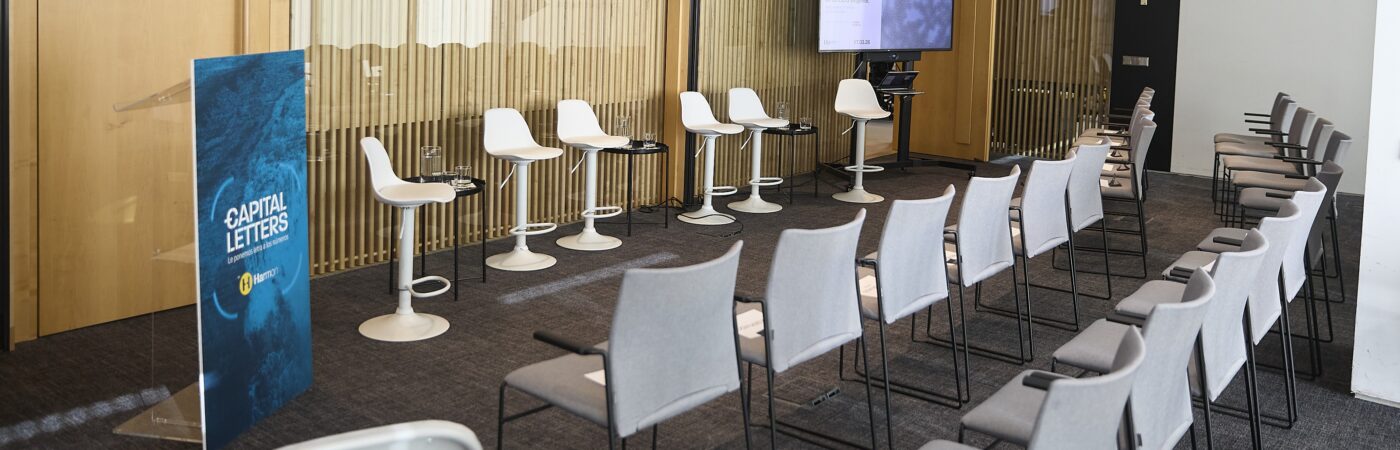
Madrid, 17 March 2026.
Harmon brought together some of the leading figures in Private Equity to address what happens when IPOs and M&A stall: how to generate liquidity from assets that were, in principle, meant to be held for the long term.
In a new edition of Capital Letters—forums where we give narrative to the numbers—the focus landed squarely on where the industry is currently under pressure: the secondary market. Not as a stopgap, but as an alternative circulatory system.
With M&A in cost-saving mode, IPOs on hold, and distributions more subdued than usual, capital has had to sharpen up. And it is doing so. Increasingly, investors and managers are turning to more creative solutions to generate liquidity and rebalance their portfolios without having to wait for conditions to improve.
The event, opened by Manuel Illueca (Chairman of ICO), brought together prominent industry figures including Emilio Olmos (CVC Secondary Partners), Sergio García (Qualitas Funds), Sonia Fernández (Kibo Ventures), Andrés Peláez (MCH Private Equity), Leopoldo Reaño (DeA Capital), Miguel Echenique (AltamarCAM), Norberto Arrate (Portobello Capital), Iñaki Arrola (K Fund), Manuel Zulueta (DC Advisory) and Ramiro Iglesias (Crescenta), among others, for a direct discussion on where capital is moving when traditional exit routes are no longer available.
Moderated by Rocío Casado (Harmon) and Montserrat Formoso (Funds People), the discussion made one point clear: timelines have lengthened, and the traditional model is beginning to fall short. When assets remain in portfolios longer than expected, waiting is no longer sufficient. Reinvention becomes necessary.
That is where secondaries come in.
From workaround to system
What was once a tactical solution is starting to look structural. Continuation Funds—vehicles set up by managers to keep extracting value from their best-performing assets—have shifted from being a niche instrument to an increasingly standard tool.
The figures support this shift: the secondary market reached approximately $240 billion in 2025, up 48%. And this is only the beginning—volumes could double before the end of the decade.
Investor appetite also follows a clear logic: reduced J-curve exposure, greater visibility, and access to assets that have already passed their most challenging phase. However, the picture is not entirely straightforward. Concerns were also raised: valuations under scrutiny, delicate alignments between existing and incoming investors, and the risk of extending asset lifecycles beyond their natural end.
If there was any consensus, it was this: the secondary market will continue to grow, become more sophisticated, and occupy a space it did not previously hold. But its ceiling will ultimately depend on something both simple and complex: the return of traditional exit routes.
Until then, capital will continue to seek alternative paths—not shortcuts.
And, judging by current trends, it is getting better at finding them.